What Is HIPAA-Compliant IT Support?
April 1, 2026
Go back to "News & Updates"
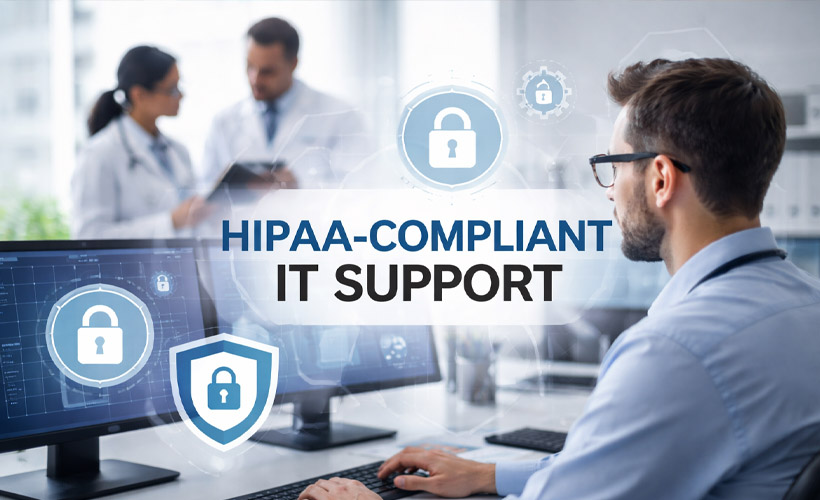
Healthcare organizations handle large amounts of sensitive data every day while depending on technology to keep patient care, scheduling, communication, billing, and documentation running smoothly.
This leads many providers to ask: What is HIPAA-compliant IT support, and why does it matter for healthcare organizations?
This article explains what HIPAA-compliant IT support means, what it typically includes, and how the right IT support approach can help healthcare organizations protect sensitive information, reduce risk, and support more stable daily operations.
1. What is HIPAA-compliant IT support?
HIPAA-compliant IT support refers to technology support services designed to help healthcare organizations manage and protect systems that store, access, transmit, or process protected health information.
It goes beyond basic IT troubleshooting. Instead of only fixing devices or software issues as they happen, HIPAA-focused IT support is built around security, access control, system monitoring, risk reduction, and operational safeguards that help support healthcare compliance efforts.
This often includes support for networks, devices, user accounts, email systems, backups, cloud platforms, and other technology used in healthcare environments.
2. Why healthcare organizations need HIPAA-focused IT support
Healthcare providers cannot treat IT the same way many other businesses do. Medical organizations handle highly sensitive patient information, rely on specialized systems, and often work in fast-paced environments where downtime can affect both staff productivity and patient care.
HIPAA-compliant IT support is important because it helps organizations build a more secure and reliable technology environment while reducing the risk of avoidable disruptions and data exposure.
With the right support in place, healthcare teams can spend less time dealing with preventable technical problems and more time focusing on patient needs.
3. Protecting sensitive healthcare data
One of the biggest reasons providers seek HIPAA-compliant IT support is the need to protect sensitive information. Healthcare organizations are frequent targets for phishing, ransomware, unauthorized access attempts, and other cybersecurity threats.
HIPAA-focused IT support helps strengthen security by improving access controls, managing updates, monitoring systems, securing endpoints, supporting safer email practices, and helping reduce vulnerabilities across the organization’s technology environment.
This kind of support is especially important because patient information must be handled carefully, and even a small oversight can create serious operational and reputational problems.
4. Managing user access and system control
Not every employee should have the same level of access to every system or record. A key part of HIPAA-compliant IT support is helping healthcare organizations control access based on roles, responsibilities, and operational needs.
This may include managing user accounts, setting permissions, reviewing access levels, supporting secure logins, and reducing unnecessary exposure to sensitive information.
Better access management helps organizations create a more secure environment while also supporting smoother workflows for staff.
5. Reducing downtime in healthcare environments
In healthcare, downtime is more than a technical inconvenience. If systems go offline or become unreliable, providers may lose access to schedules, records, communication tools, billing platforms, or other critical systems.
HIPAA-compliant IT support helps reduce downtime by proactively monitoring systems, identifying issues early, applying updates, maintaining infrastructure, and resolving problems before they grow into larger disruptions.
This is especially valuable for healthcare organizations that need consistent system performance but do not have an internal team available to manage every issue around the clock.
6. Supporting secure backups and recovery planning
Security is not only about preventing threats. Healthcare organizations also need to be prepared to recover quickly if something goes wrong.
HIPAA-compliant IT support often includes backup management, disaster recovery planning, and business continuity support to help protect important data and restore operations after incidents such as cyberattacks, hardware failures, or accidental data loss.
A strong recovery strategy helps reduce downtime, limit disruption, and improve organizational resilience during unexpected events.
7. Device, endpoint, and network protection
Healthcare organizations use a wide range of connected technology, including desktops, laptops, tablets, printers, mobile devices, and other networked equipment. Each of these can create potential security and performance risks if not managed properly.
HIPAA-compliant IT support helps secure these environments through patch management, endpoint protection, network oversight, firewall support, configuration management, and routine maintenance.
By taking a proactive approach, providers can better protect both their systems and the sensitive information that flows through them.
8. Cloud and remote technology support for healthcare
Many healthcare organizations now rely on cloud-based tools, hosted platforms, and remote access solutions to support operations across offices, departments, or distributed teams.
HIPAA-compliant IT support helps organizations use these technologies more safely by guiding implementation, configuring secure access, maintaining visibility, and supporting ongoing management after rollout.
This makes it easier for healthcare teams to benefit from flexibility and efficiency without overlooking security responsibilities.
9. Ongoing support instead of one-time fixes
HIPAA compliance and healthcare IT security are not one-time projects. Risks change over time, staff needs evolve, systems grow more complex, and new threats continue to appear.
That is why HIPAA-compliant IT support works best as an ongoing service rather than a reactive break-fix model. Continuous oversight, maintenance, and support help healthcare organizations stay more secure and more stable over the long term.
A proactive IT partner can help providers adapt to change, improve reliability, and build a stronger operational foundation as their needs grow.
Final thoughts
HIPAA-compliant IT support helps healthcare organizations protect sensitive information, improve system reliability, reduce downtime, and support safer day-to-day operations.
Rather than only solving technical issues after they happen, this type of support focuses on prevention, security, access control, backup planning, and ongoing maintenance that align with the realities of healthcare environments.
For providers looking to strengthen both technology performance and data protection, HIPAA-compliant IT support is an important part of building a more secure and dependable healthcare organization.